Why Choose Mechanical at ACE?
The Department of Mechanical Engineering at ACE Engineering College, accredited by NBA in 2018 and 2022, stands as a pillar of innovation and hands-on learning. Backed by the institution’s NAAC ‘A’ Grade and Autonomous Status, the department offers a future-focused curriculum blending fundamentals of thermodynamics, machine design, fluid mechanics, and advanced manufacturing. Students are trained in modern tools such as ANSYS and CREO and exposed to CNC machines and automation labs that simulate real industrial settings. With strong placement support, GATE coaching, and dedicated training for interviews and soft skills, the department nurtures well-rounded engineers. Alumni from ACE Mechanical have gone on to lead in industries, research, and entrepreneurship—testament to a legacy built on excellence, innovation, and industry readiness.Accreditation


Vision & Mission

Our Vision
To achieve excellence in mechanical engineering education and research by fostering innovation and pioneering solutions for industrial and societal needs.
Our Mission
- Equip students with a solid foundation in thermodynamics, machine design, and advanced manufacturing technologies.
- Promote research projects focusing on sustainable energy and automation technologies.
- Encourage professional practices that emphasize ethics, environmental consciousness, and lifelong learning.
- Facilitate collaborations with industries for real-world technical problem-solving engagement.
Curriculum Syllabus
Program Education Objectives
Program Educational Objectives (PEOs)
PEO 1: To impart high quality technical skills and comprehensive knowledge in Mechanical Engineering along with basic sciences, applied mathematics and other disciplines.
PEO 2: To apply modern scientific tools and cutting-edge technologies for designing, modeling, analyzing the real time Mechanical and other allied Engineering problems.
PEO 3: To prepare the students for successful careers in Mechanical Engineering and to cater the needs of Stake holders by imparting social responsibility towards professional ethics, technical, economical and environmental related issues.
PEO 4: To inculcate entrepreneurial skills, leadership qualities, team spirit and lifelong learning to achieve career goals.
Knowledge and Attitude Profile (WK)
WK1: A systematic, theory-based understanding of the natural sciences applicable to the discipline and awareness of relevant social sciences.
WK2: Conceptually-based mathematics, numerical analysis, data analysis, statistics and formal aspects of computer and information science to support detailed analysis and modelling applicable to the discipline.
WK3: A systematic, theory-based formulation of engineering fundamentals required in the engineering discipline.
WK4: Engineering specialist knowledge that provides theoretical frameworks and bodies of knowledge for the accepted practice areas in the engineering discipline; much is at the forefront of the discipline.
WK5: Knowledge, including efficient resource use, environmental impacts, whole-life cost, reuse of resources, net zero carbon, and similar concepts, that supports engineering design and operations in a practice area. WK6: Knowledge of engineering practice (technology) in the practice areas in the engineering discipline.
WK7: Knowledge of the role of engineering in society and identified issues in engineering practice in the discipline, such as the professional responsibility of an engineer to public safety and sustainable development.
WK8: Engagement with selected knowledge in the current research literature of the discipline, awareness of the power of critical thinking and creative approaches to evaluate emerging issues.
WK9: Ethics, inclusive behavior and conduct. Knowledge of professional ethics, responsibilities, and norms of engineering practice. Awareness of the need for diversity by reason of ethnicity, gender, age, physical ability etc. with mutual understanding and respect, and of inclusive attitudes.
Program Outcomes (POs)
- Engineering Knowledge: Apply the principles of computing, mathematics, science, and engineering to solve complex computer science problems.
- Problem Analysis: Identify, analyze, and interpret complex computing challenges using principles of mathematics and algorithmic reasoning.
- Design and Development of Solutions: Design software systems, components, or processes that meet desired needs with attention to functional, ethical, and societal constraints.
- Investigation of Complex Problems: Use research-based knowledge and methods to conduct experiments, analyze data, and derive valid conclusions in computer science domains.
- Modern Tool Usage: Create, select, and apply appropriate techniques, resources, and modern IT tools to engineering activities, including system design and evaluation.
- The Engineer and Society: Apply contextual knowledge to assess societal, legal, and cultural issues relevant to professional engineering practice.
- Environment and Sustainability: Understand the impact of professional engineering solutions in societal and environmental contexts, and demonstrate knowledge for sustainable development.
- Ethics: Commit to professional ethics, responsibilities, and norms of engineering and digital practice.
- Individual and Team Work: Function effectively as an individual, as a team member, or as a leader in multidisciplinary and diverse environments.
- Communication: Communicate effectively on complex engineering activities, including documentation, reports, presentations, and clear instructions.
- Project Management and Finance: Demonstrate knowledge of engineering and management principles to lead projects and manage resources in multidisciplinary contexts.
- Lifelong Learning: Recognize the need for, and possess the ability to engage in independent and lifelong learning in the context of technological change.
Program Specific Outcomes (PSOs)
- Specialize in automation and robotics, designing advanced machinery for industrial applications.
- Utilize computational tools like ANSYS and CREO for precision-based design and analysis.
Faculty & Research









Infrastructure & Labs
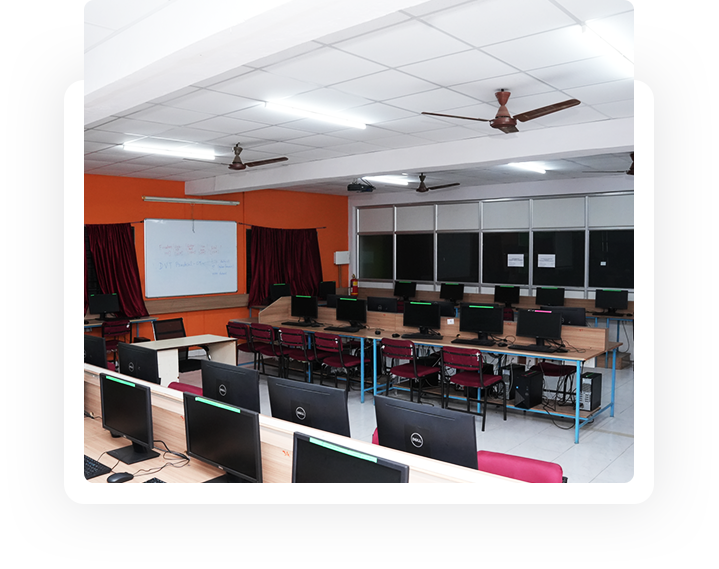
The Mechanical Engineering department is supported by cutting-edge infrastructure that promotes experiential learning:
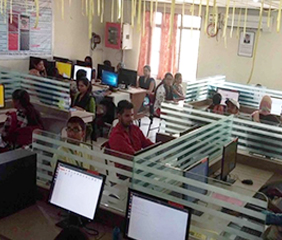
CAD/CAM, Fluid Mechanics, and Heat Transfer Labs powered by industry-grade simulation tools
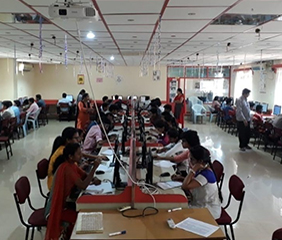
CNC Machines for prototyping and advanced manufacturing practice
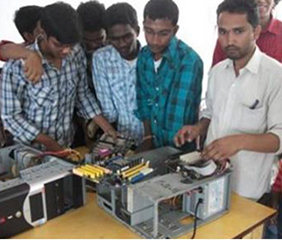
Mechatronics and Automation Labs for robotics and control systems training

92+
Campus Interviews Conducted

156+
Campus Interviews Conducted

31+
Campus Interviews Conducted

500+
Campus Interviews Conducted
Our Tap Recuiters







Placements Highlights – 2021 – 25
72
Campus Interviews Conducted
9
Programs Available for the Students
46.38L
Highest Package 46.38LPA in Amazon
434
Successful Campus Placements
Our Tap Recuiters
Advisory Board Members
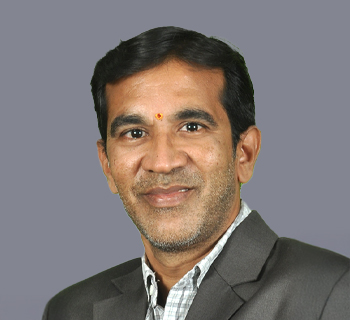
Head of the Department
Dr. M. Nitin Kumar
Professor & HODSenior Faculty Members
Dr. G. BalaRaju
ProfessorMr. CH. Raju
Assistant ProfessorMr. C. Venkatesh
Associate ProfessorMr. M. Sandeep
Associate ProfessorProject coordinator
Mr. A. Abinay
Assistant ProfessorStudents
Mr. Suthari Punith Kumar
IV MechanicalMr.Bollavena Suresh
III MechanicalMs. Seelam Mahalakshmi
IV MechanicalMr.Jula Rahul
III MechanicalParents
Mrs.Aruna jyothi
Govt gurukula teacherMr.Mangalpally Yakaiah
Govt.TeacherAlumni
Mr.Md.Abrar
BYJUS , Business Development AssociateMr.B.Sandeep
Trainee Engineer, TCS HyderabadProfessional Bodies Members
Dr.Sri Ram Venkatesh
Professor of Mechanical Engineering UCE Osmania University HyderabadDr.K Sridhar Reddy
Professor of Mechanical Engineering JNTU KarimnagarEmployers
Dr.P.Srinivasa Rao
Manager, Technical Training, Cyient Limited.Mr.A.Dayanada Reddy
Managing Director Vasantha Tool Crafts Pvt.Ltd Jeedimetla HyderabadManagement
Prof. Y. V. Gopala Krishna Murthy
General Secretary, ACE Engineering CollegeAdvisory Board Members
Chairperson (HOD)
Dr. K.Prem Kumar
Associate ProfessorMembers
Mr.Y.Chandramouli
Assistant ProfessorMr. KVDS.Santosh
Assistant ProfessorClass Representative
Mr. Saad Ali Khan
Roll Of Honour

Garnepally Thirumal
H : No : 22AG5A0303
BATCH : 2021-2025

Kodityala Laxmi Narsimha
H : No : 21AG5A0307
BATCH : 2020-2024

Porandla Nithin
H : No : 21AG5A0309
BATCH : 2020-2024

Rachakonda Soman Dixit Subramaniyam
H : No : 19AG1A0318
BATCH : 2019-2023

G Radhakrishna
H : No : 19AG5A0319
BATCH : 2018-2022

K Saketh Reddy
H : No : 17AG1A0382
BATCH : 2017-2021

S Shiva Kumar Goud
H : No : 17AG5A0321
BATCH : 2016-2020

Jince Joseph
H : No : 15AG1A0372
BATCH : 2015-2019

G Sashank
H : No : 14AG1A0393
BATCH : 2014-2018

Chinthoju Karthik Kumar
H : No : 13AG1A0325
BATCH : 2013-2017

Ganapuram Rakshith
H : No : 12AG1A0338
BATCH : 2012-2016

Shubham Arvind Tupkar
H : No : 11AG1A0352
BATCH : 2011-2015
Events & Activities
No upcoming events found.